
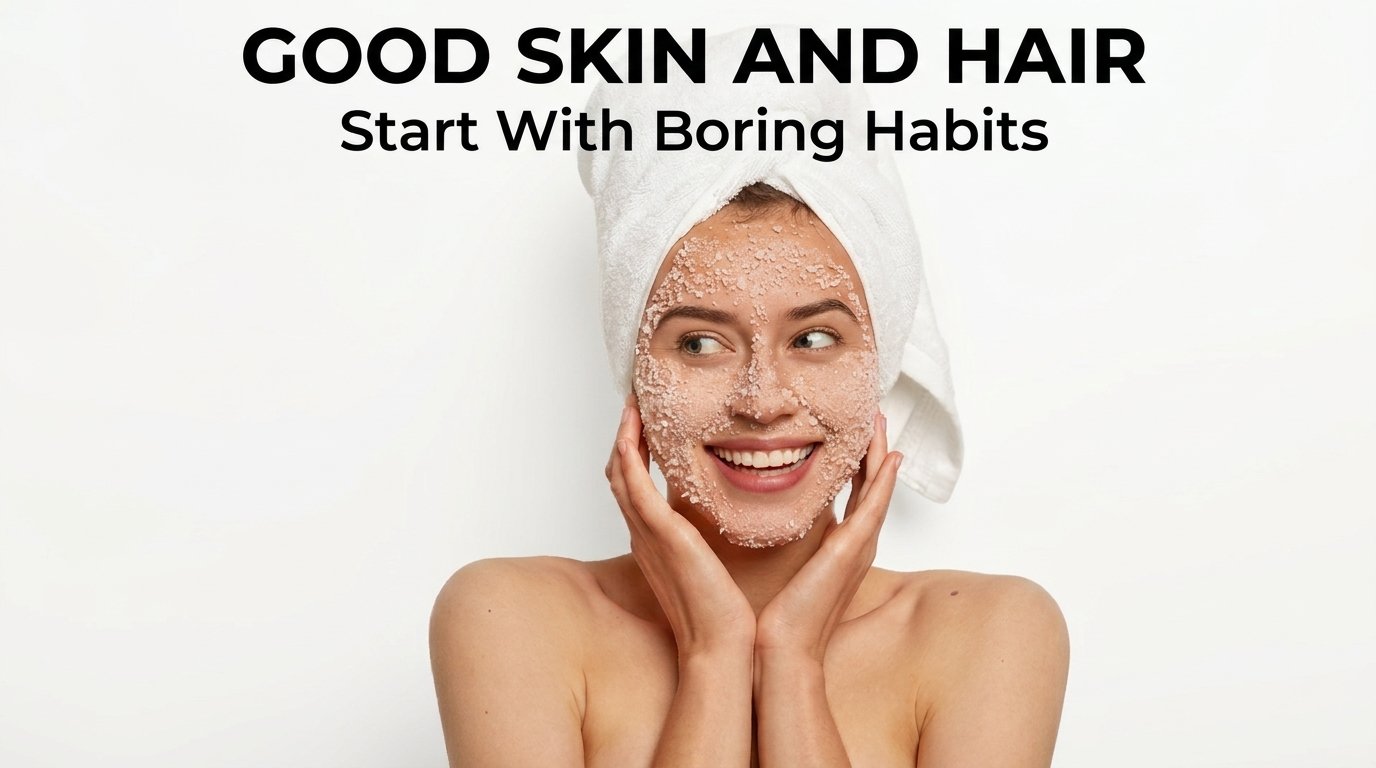

In a four-and-a-half-year Australian randomized trial involving 903 adults, people assigned to use broad-spectrum sunscreen daily had 24% less skin aging than those told to use it at their discretion. The daily-use group showed no detectable increase in photoaging over the course of the study. That is a more persuasive result than any glossy bottle promising “radiance in seven days.”
Healthy-looking skin and hair are not entirely under personal control. Genetics, hormones, medications, eczema, acne, androgenetic hair loss, and autoimmune disease all matter. But the ordinary choices still carry unusual weight: what happens in the bathroom, what happens at bedtime, and what happens when heat styling becomes a daily reflex.
Protect Skin From the One Exposure That Never Takes a Day Off
Ultraviolet exposure is the most preventable source of visible premature aging. Fine lines, uneven pigment, roughness, and loss of elasticity all accumulate gradually, which is precisely why sun protection can feel unglamorous. It works quietly.
The American Academy of Dermatology recommends sunscreen that is broad-spectrum, water-resistant, and SPF 30 or higher. Broad-spectrum matters because it covers both UVA and UVB radiation; SPF alone is not the whole story. The organization also advises reapplying about every two hours outdoors and after swimming or heavy sweating. (aad.org)
Make sunscreen a morning default
A practical routine is to apply sunscreen to the face, ears, neck, and other uncovered skin as the final step of a morning skincare routine. If makeup makes reapplication awkward, use shade, a hat, sunglasses, and tightly woven clothing as additional defenses rather than pretending the original morning layer will last through an afternoon outside.
This is not a demand for fear of daylight. A walk is good for most people; burning is not. The point is to stop treating tanning and accidental exposure as harmless cosmetic events.
The randomized sunscreen study also punctures a persistent beauty-industry fantasy: its beta-carotene supplement arm did not show an overall anti-aging benefit. Protection beat supplementation. A hat is less exciting than a cabinet of powders, but it is also more likely to help.
Stop scrubbing skin into submission
The second habit is restraint. Dermatologists recommend a gentle, non-abrasive cleanser, lukewarm water, fingertips instead of abrasive cloths or scrubs, and washing the face no more than twice daily plus after heavy sweating. Scrubbing can irritate skin and aggravate conditions including acne.
Moisturizer is not merely for people with visibly dry skin. Applied to damp skin, it helps retain water in the outer layer. People prone to acne can look for labels such as “non-comedogenic,” “oil-free,” or “won’t clog pores.” The goal is a stable skin barrier, not the squeaky-clean sensation that often signals over-cleansing.
Dr. Marisa Garshick, a board-certified dermatologist quoted by the American Academy of Dermatology, puts the philosophy plainly: consistency with fewer products matters more than a 10-step routine. That should be liberating. Your skin does not need to be treated like a laboratory experiment every Tuesday.
7-daily-habits-for-glowing-skin-shiny-hair
Sleep Is a Cosmetic Habit With Better Evidence Than Most Serums
“Beauty sleep” sounds like advertising language, but sleep loss has measurable effects on skin.
In a 2022 study led by sleep physician Damien Léger, 24 healthy women ages 30 to 55 slept only three hours a night for two consecutive nights. Researchers found lower skin hydration, higher transepidermal water loss, reduced elasticity measures, and declines in facial brightness and color saturation. It was a small study, and it cannot tell us that one bad night permanently ages a face. Still, it makes the short-term costs of chronic exhaustion hard to dismiss.
Another study of women in their forties found that limiting sleep to four hours per night for six nights reduced hydration and worsened measures of gloss, elasticity, texture, and wrinkles. Good skin is not produced by sleep alone, but poor sleep makes every other effort work against a steeper gradient.
Aim for enough sleep, not perfection
For adults ages 18 to 60, the CDC recommends seven or more hours of sleep per night. In 2024, 30.5% of U.S. adults reported averaging under seven hours in a 24-hour period. This is not a niche wellness concern; short sleep is normal enough to be culturally shrugged off, even when it shows up on the face.
The workable habit is a consistent wake time, morning daylight, and an evening that does not stretch indefinitely under a phone’s glare. A single late night is not a dermatologic catastrophe. Repeated sleep deprivation is different.
Hair Health Depends on the Scalp, the Strand, and the Styling Routine
Hair is dead fiber once it emerges from the scalp. That sounds bleak, but it clarifies the job: you cannot biologically “heal” a split end. You can reduce breakage, preserve the cuticle, and avoid traction that can eventually damage follicles.
The American Academy of Dermatology advises shampooing according to how quickly the scalp becomes oily or dirty, concentrating shampoo on the scalp rather than rubbing it down the hair shaft. Conditioner after shampooing reduces tangling and makes hair easier to manage. For straight or fine hair, conditioner may suit the ends best; dry, curly, or textured hair often benefits from conditioner through the length.
Lower the heat and loosen the pull
Excessive heat damages every hair type. The sensible rule is low or medium settings, fewer heat-styling sessions, and partial air-drying when possible. Flat irons should be used on dry hair; curling irons should touch each section briefly. The AAD suggests aiming for hot tools once a week or less when feasible.
Tension is the other enemy. Constantly tight ponytails, buns, braids, cornrows, and extensions can cause breakage and traction alopecia. Continued pulling can lead to permanent hair loss, which is why “it looks neat” is not a sufficient defense for a hairstyle that hurts. Rotate styles, reduce tension, and treat scalp pain as a warning, not a beauty tax.
Wet hair needs a different kind of patience. It breaks more easily, so rough towel rubbing and aggressive brushing are counterproductive. A wide-tooth comb and slow detangling from the ends upward are mundane techniques, but they beat expensive repair products applied after the damage is done.

Eat Enough, Be Skeptical of “Hair-Skin-Nails” Pills
Crash dieting and restrictive eating can show up in the mirror as dry skin, brittle nails, and shedding hair. Severe nutritional deficiency is a genuine medical issue, not a cosmetic one. Reviews of androgenetic alopecia research find associations between hair loss and deficiencies or imbalances involving nutrients such as iron, vitamin D, and zinc, but the evidence is inconsistent and does not justify indiscriminate supplementation.
That distinction matters. If hair loss is sudden, patchy, accompanied by scalp symptoms, or substantially greater than usual, the answer is not automatically biotin. A clinician can consider causes ranging from iron deficiency and thyroid disease to medication effects, postpartum shedding, infection, or autoimmune conditions.
Biotin deserves special skepticism. The NIH Office of Dietary Supplements says the evidence for biotin improving hair, skin, or nails in healthy people is limited largely to case reports and small studies; true biotin deficiency is rare. A deficiency can cause hair loss, but that does not mean megadoses help everyone with a hairbrush full of strands.
Build meals around adequate energy and protein, varied produce, legumes, whole grains, dairy or fortified alternatives, eggs, fish, meat, tofu, nuts, and seeds according to personal preference and medical needs. Then investigate symptoms rather than chasing the supplement aisle’s promises.
The healthy glow people chase is usually less mysterious than it appears: protected skin, a calm barrier, enough sleep, gentler hair handling, and the willingness to seek medical help when the problem is more than cosmetic. The unresolved tension is that these habits are almost too simple to sell. That is also why they endure.